Sankofa and the American Evolution: Going Back to Go Forward— Tulaine Montgomery at TEDxBoston
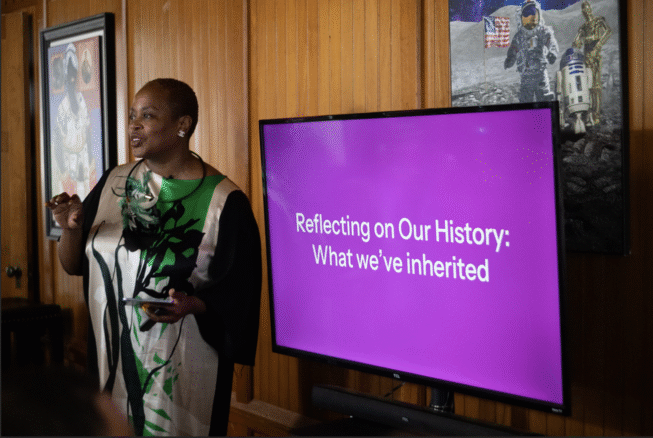
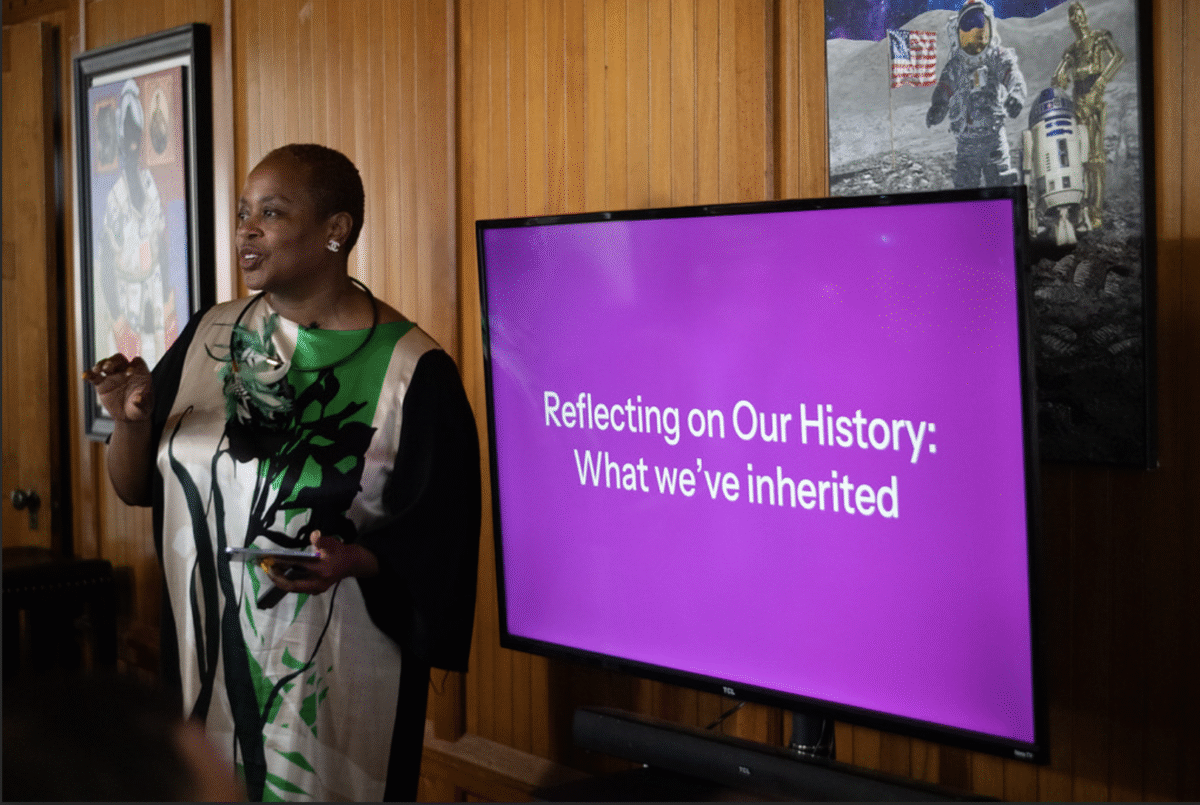
The following is a transcript of Tulaine Montgomery’s talk with TEDxBoston, “Sankofa and the American Evolution: Going Back to Go Forward.” It has been lightly edited for clarity.
Listen. It is not sentimental to go back for what you left behind.
That’s the English translation of a proverb from the Akan people of Ghana, and from that proverb comes the term Sankofa, which loosely translated means to go back and get it. Sankofa encourages us to learn from our past in order to inform a better and wiser future.
It reminds us to reach back as we prepare to move forward, and it entreats us to lift as we climb. These are the principles of Sankofa, and I’m going to talk today about what we are meant to do at a time such as this, when the very premise of democracy is at stake. What is our role? What is our work? What is our challenge and what is the beautiful opportunity that may not be immediately visible to us?
Recommitting to the evolution of America at 250 years
I know I am not the only one in the room who has what I’m going to go ahead and call complex feelings as I entertain that America is approaching its 250th birthday. With a show of hands, who among you has some complex feelings? It’s not just a straight line! It’s a collective experience.
For better and for worse, this country has always had multitudes. There have always been very painful contradictions in this country.
Since the founding, America has made bold promises that have truly inspired the world. No nation has aspired to do what this nation has aspired to do. Not a one. America’s aspiration is unmatched. But for too many of us, and some would say most of us, the poetry has not yet met the practice.
And yet, in spite of this being true, we continue. We continue to build, we continue to long for that alignment between poetry and practice, and we continue to imagine something different. So I’m going to invite you to hold on to the fact that even though this nation has not ever fully met all the possibilities, that it most certainly could, and the time for us to make that possibility real is right now.
As a student of history and a futurist, I’m going to suggest that we must understand the past that we’ve inherited in order to shape the future that we all deserve.
So I invite you to see this milestone in our nation’s history as a moment to reflect, reimagine and recommit. And yes, I am asking you to recommit at a time where our news feeds and even our own exhaustion might invite us to throw our hands up. We may be overwhelmed, depleted, exhausted at the idea of gearing up anew. But I am going to invite you to recommit, because now is the time and so we need to take a deep breath together amidst all this turbulence and ask ourselves some really important questions.
What do we want to become as a nation?
This is our home.
What do we want this nation to become? How do our systems, structures and the way that we relate to each other – how do all of those things need to be interrogated and evolved?
And what’s at stake?
Why is the evolution of America worthwhile work? There are some who say the time has passed, it’s too late. But I believe that nothing could be further from the truth.
Asking the hard questions
Let’s start by reflecting on our history. America’s story is complex. It is both brilliant and brutal; it is beautiful and deeply broken. We’re a nation that is founded on bold ideals of freedom, built on stolen land with stolen labor. So the contradictions are intense and painful. They coexist and they ebb and flow with the tides of history, and we are living in history in this present moment.
Over the years, you know, I’ve had different roles. I am still a cellist, but as a teacher and an artist, as an entrepreneur and as a member of community, there’s one thing that I’ve really learned: we must be willing to take forward what’s serving us and leave what does not work behind.
This requires us to examine, to truly examine, our systems, our mindsets and our relationships. It requires rigorous inquiry. We have to ask ourselves the hard and sometimes hidden questions. Things like: how do we as individuals, as leaders, engage with the systems around us? Where are we perpetuating harm? There is no identity that keeps us from, in some way, perpetuating harm if we don’t investigate and interrogate. To what extent are our minds steeped in binaries, either/or thinking that reduces people to two dimensional caricatures instead of holding space for the complexity of their humanity? This is not the time to put people easily into solid categories. When somebody does a thing that typically you would say means they are one of them, this is the time to pause. To breathe. To consider that you don’t actually have all the information you need to do the work that needs to be done.
The genius of proximate leaders
One truth about America that has persisted from its founding to today is that there is an abundance of genius in communities all over this country. There are magical places all over this incredible nation. So what can we do to get more access to the magic? [How can we] invest in leaders who are what we at New Profit call proximate?
What we mean by [proximate] is not representation and identity politics. What we mean is people who are immersed in a system, immersed in a community, and have deep expertise that we need. We can no longer say we want to change the systems and change the world, but overlook the input of people whose experience may be different from our own.
This is important because a lot of our formal structures of power and resource use what we call lazy proxy.
What school did you go to?
Whose family are you from?
Do you talk the way that I talk?
Is there somebody who has power who can vouch for you?
We call those lazy proxies. And I would offer that if the interest is to contribute to the evolution of America, that we must all immediately and permanently get out of the business of using those lazy proxies.
It doesn’t mean we can’t have community and tribe and places that feel like home. Those places matter, but we can’t confuse our circle with our broader community. There’s a difference there.
A new future is coming
Let’s go into a little bit of imagining our future.
In 2042, there will be no single racial majority in the United States of America.
Let that sink in.
For a nation that was founded and centered around core ideas and constructs around race and hierarchies of value based on race – in 2042 there will be no single racial majority.
In addition, we’re living in the most age-diverse time of our history as a species.
Right now, in many communities, we have six generations living in community.
Many of you are leading businesses where you have young folks and folks who are perhaps a bit more seasoned, working side by side. There’s lots of jokes and comedy around intergenerational work. It means that, hey, you have some folks who think that zooming and pinching a screen is the most natural thing in the world. They see a flat screen, they want to touch it! Sitting and working alongside people who have the largest font option on their phone. There’s no shame or shade in that for me. Sometimes it is easier to read larger font, and there’s nothing wrong with that!
But we haven’t yet practiced or built the institutions that allow us to leverage the power and beauty of such a range of capability and orientation. We have institutions and habits that teach us that that is a problem, that that is a nuisance, that that is something we need to work around and fix, as opposed to dig into. We use lazy proxies.
The time to evolve is right now
The other piece I want you to think about when we consider American evolution is that this is quite a moment. If we’re saying that we have the most diversity of race, culture, and ethnicity, and we have the most age diversity that we’ve ever had, isn’t that a moment that is rich with possibility?
Consider that if we have more resource, more insight, more perspective than we’ve ever had, then this is the time to evolve this nation. It’s actually right now, even though it feels like this is the most difficult moment that we have lived through together. And in some ways it is, but it is also that rich with opportunity.
The Tools We Need to Evolve
Let’s talk about what’s required of us.
There’s a few tools that I would offer we need if the goal is to recommit to an American evolution.
Tool 1: Accelerate trust through adjacent action
One is we must accelerate trust, especially when it feels like that is the hardest thing in the world to do.
There are lots of ways we human beings build trust, but the method of trust I’m going to offer to you today is what I call adjacent action: when we human beings sit shoulder to shoulder and solve a problem together.
When we human beings build something together, when we human beings learn and study something together, we build a trust that is accelerated, deep, and durable. So we need to find ways to do adjacent action with people, even those who we may not recognize immediately as safe, as knowable, as familiar. We have to really consider this. Samoan climate activist Brianna Fruean told me, “I don’t work with people who are like-minded. I work with people who are like-hearted.”
What that means to me is, I’m not that interested in your tactics and your pre-approved methodology–that’s all open for renegotiation. What I want to know is, do you long for the same things I long for? For yourself, for your family, for your community? That’s like-hearted. And if we’re like-hearted, then we can figure out what our shared work actually looks like.
Tool 2: Proximity and partnership
The next tool for recommitting to an American evolution is proximity and partnership. If we want to identify solutions, then we have to get better at letting lazy proxies go and recognizing excellence that may not be familiar.
At New Profit, I am energized because I work with hundreds of America’s problem solvers, whether it is entrepreneurs, organizers, philanthropists, investors. I’m part of an ecosystem of people who have made a commitment to make things better, who are finding ways to connect across difference, and I’m telling you, the evidence is abundant that the solutions are here. They’re not in our news feeds. They’re not part of the public political discourse. But there are many, many places where those who want a thriving nation are winning and succeeding. I get to see that every day at New Profit and I want all of us to see that.
I want all of us to have the communities and habits that allow us to know that there are more of us who want people to have opportunity and choice and sovereignty than there are those who do not wish that for everyone. There’s some folks like that out there, but they’re much smaller in number than we’re being led to believe. If you’re in proximity, you can see that and live that in the ways that I do.
Tool 3: Radical imagination
The last piece is radical imagination.
Toni Morrison said, “Dream the world as it ought to be. Don’t let anybody, anybody convince you this is the way the world is and therefore must be. It must be the way it ought to be.”
These are words that need to be really internalized and understood. Dream the world as it ought to be. Don’t let anybody, no matter what studies they’ve done, credentials or followers they have, convince you that this is the way the world is, and therefore must be. That’s the story we’re being told, that it must be this way, that there is not the possibility this is the moment of transformation. But we’re being misled. It must be the way it ought to be.
I want all of us to remember that and be prepared to remind each other of that, because it gets easy to forget in the kind of time that we’re living in.
People talk a lot about the word radical, and radical gets a bad rap. It’s been politicized in a way that is confusing. The Latin root of the word radical is actually root, getting to the core of a thing. That’s why radical surgeries are about a core feature. That’s why radical ideas are about the root of a system.
When we talk about radical, it’s not about fringe. Quite the opposite. The radical is about the core.
Community is lifeblood
The last, and maybe even the most important, is constellations and coalitions.
I mentioned earlier that at New Profit, I literally know and get to engage with hundreds of America’s problem solvers. Many of them are here in this room. Many of you are part of what makes New Profit an entity in a world where problem solving is happening. I would offer that there are many worlds like this, and so we need to make time to be together.
We need to be in community in this way. If you’ve ever been somebody who thought, well, I’ll get to that community stuff after I meet these goals, let me encourage you to reconsider.
This is a time where community is medicine. It is as essential as water. In fact, it is more than medicine. It is lifeblood.
If we are going to enable an American evolution, then we must pour into communities and coalitions.
In closing: like everyone in this room, I stand on the shoulders of giants. I stand on the shoulders of my ancestors. There is nothing that I am facing that is more than what I can handle, not because I am so great, because I am not, but because I am in community, because I am accelerating trust, because I am in proximity to people who are doing brilliant work, and because I believe that the choices that we make now, what we normalize, the stories we tell, I believe that they’re going to shape the story that we tell at the next milestone.
So I invite you to be part of an American evolution with me and with one another.
The future is going to be shaped by us.
This is not a moment that is beyond us. It is filled with difficulty and it is fraught – this is true – but look at the resource we have in this room, and beyond this room.
Join me in an American evolution.