Painting the possible: What does it really look like to build a democracy where all can thrive?
For those of us seeking to strengthen American democracy in 2026, it can feel nearly impossible to just keep up with the day’s developments, let alone trying to envision the distant future. And yet, people cannot build a democracy they can’t imagine.
At New Profit, we invest in social entrepreneurs who are expanding access and opportunity in the United States, particularly in the issue areas of education, economic mobility, and democracy–three critical and intertwined systems. At the moments when government or the market are not well-suited to address the challenges at hand, philanthropy can invest in the people and organizations who are building and dreaming what American democracy can become.
New Profit’s democracy strategy is to support work that strengthens civic capabilities and work that paints the possible of what American democracy can and must become. To us, democracy work requires both halves of that equation: what do we need now, and what will we need in the future?
The word dreaming may not feel practical, but when it’s grounded in day- to- day effort, dreaming is absolutely critical to building the next chapter of our democracy. There remains a big gap between recognizing the need to reimagine how we govern ourselves and our actual capacity to design and build more collaborative and effective ways of solving our shared problems. There’s room for more dreaming to be happening.
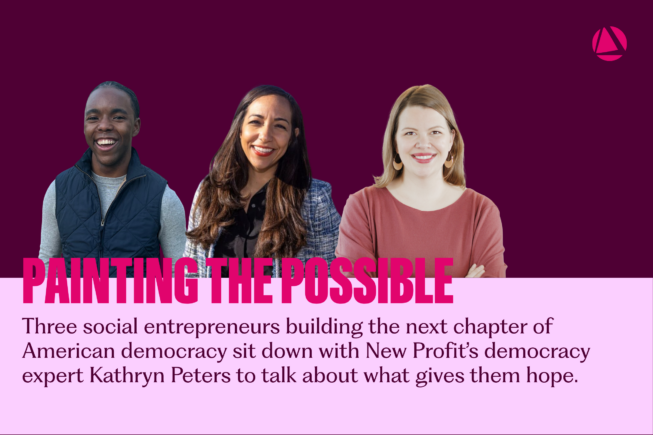
To better understand how leaders in democracy work are dreaming, building, and hoping, I sat down with three organizations in the New Profit portfolio who are leading work to defend and expand American democracy.
Here are three takeaways from our conversation.
1. Yes, the challenges facing our democracy feel enormous. But that doesn’t erase the real power each individual holds, and the concrete changes we can win in our lifetime.
“Leadership matters,” Layla Zaidane, President & CEO of Future Caucus reminded me. Future Caucus works directly with our nation’s leading young policymakers at both the federal and the state level to bridge the partisan divide and lead a new era of collaborative governance–and it works! A recent analysis by the Center for Effective Lawmakers found that policymakers who participate in a Future Caucus are 24% more effective than their peers. “Being a part of a piece of civic infrastructure that enables you to build relationships, to practice solving problems, to have healthy conflict, and get to resolution – that makes you more effective than people who are not,” said Layla. “When you imagine these big giant problems, we often forget the agency each of us has as individuals. If we can equip leaders to navigate an environment in which they’re having to make tough calls and do things for the good of something much, much bigger than themselves, we get to this vision [of a future, stronger democracy].”
Individual voters hold power, too–not just elected officials. Rebecca DeHart, CEO of Fair Count, points to an organizing success story following the Supreme Court’s decision in Louisiana v. Callais last October. Fair Count, which builds long-term power within historically undercounted communities, was on the ground when the decision was handed down. “[There was a] groundswell of people who were angry, who wanted to be heard, who felt like if they could just talk to someone and tell their story that it would make an impact on their daily lives, but they didn’t know how to do it, didn’t know how to plug in. In just a few weeks’ time, we were training community members in how to testify with their local elected officials down at the Capitol. We mobilized thousands of people to show up the day our special session was supposed to start. Thirty minutes before the special session in Georgia was supposed to start, the legislators decided that they would not be redrawing the maps, because the people of the state stood up and said, ‘This isn’t okay with us. You can’t rush this. This is our lives.’”
2. Dreaming the next chapter of American democracy means being willing to evolve and meet people where they are.
“If I were deciding where dollars are going to be allocated, I would be investing in storytelling,” Shawon Jackson of Vocal Justice told me. His organization, which inspires and prepares youth to be lifelong leaders for liberation, partners with educators to transform learning spaces into healing-centered communities that strengthen community critical consciousness and communication skills. “We have to meet people where they are, and we have to speak in really plain ways about why this work matters. What does it mean about whether or not potholes are going to get filled in your streets? What does it mean about whether or not your grandmother is going to be able to afford the medicine that she needs? What does it mean about whether or not your teacher is going to get enough pay to be able to support your little brother who just started third grade? Simplifying our messaging does not mean dumbing it down. It means making it accessible.”
Meeting people where they are includes acknowledging that for many people, their experience of American democracy has been one of disenfranchisement. “What is the balance between positive reinforcement, [sharing] the stories that invite people to be a part of the institutions that undergird our country that are worth defending, and being really bright-eyed and honest about opportunities for improvement and what we’re allowed to improve?” Layla added. Fortunately, as she pointed out, “Democracy includes within it the tools that have expanded the right to vote. The tools for more democracy are included within democracy.”
New structures beyond the status quo are possible, and democracy workers are already dreaming up changes that could be closer than we think, like enshrining voter rights protections at the national level. “I’ve worked in a lot of states over my career of 25 years in voting rights, and every state is different,” said Rebecca. “You go to Florida, and every county is different. And there’s something about being here in the 250-year anniversary, and still fighting as state legislatures make changes to voting and who can access the polls, and who it’s going to be harder for, and how do organizers like us provide the education and the mobilization for them to find that pathway to success. It’s exhausting, and I think America deserves better than that.”
3. Democracy work is intergenerational. Young people’s experiences now shape their lifelong understanding of civic engagement and their own role in shaping our country’s future.
Through his work leading Vocal Justice, Shawon witnesses young people finding their hope for the future through action. He points to a group of students in California who organized around including more identities in the state’s ethnic studies curriculum: “They interviewed students, teachers, people in their communities. They went to a local school board meeting to talk about why this work matters, and to advocate for a young person to have some formal decision-making authority on a body to shape what their curriculum looks like.” Not only does Shawon draw inspiration from this kind of organizing, he sees it as an example of how young people are changing how they understand their role in society. “One of the things that I see as truly possible is redefining the purpose of education to not just be about civic literacy, but cultivating civic leadership. [We can] understand schools as places that don’t just prepare us to enhance our economic mobility, as important as that is, but to develop the mindsets and the skill sets that are required to be active participants and curators of our democracy.”
While all generations can be energized by young people’s activism, current leaders also have the opportunity to present a model of civic leadership that inspires those coming next. “If you look back at moments of great national accomplishment, like the height of the space race and the moonshot, high school students had astronaut as their top job,” Layla pointed out. “Thirty years from now I would love to see public service become an honorable calling that young people want to have.”
Kathryn Peters is a Partner on the New Profit Portfolio team. Previously, she served as the inaugural executive director of the University of North Carolina’s Center for Information Technology and Public Life, and co-founded Democracy Works, an organization that reached millions of voters through programs like TurboVote and the Voting Information Project.