The Only Constant is Change: How Philanthropy Can Evolve in this Era of Uncertainty
The challenges that mission-driven organizations are confronting today demand a new kind of philanthropic response. They also provide an opportunity to evolve our practices and relationships across the social impact sector. For donors and funders, it calls for approaches that are collaborative, community-driven, and patient: investing in leadership and organizational resilience in addition to direct service delivery. For social entrepreneurs and nonprofit leaders, it means being candid and transparent about the headwinds and their impacts on organizational health. And for all of us, it means building communities of support rather than going it alone.
Many of us have been in this work long enough to know that every era feels like the most challenging one we’ve faced. And yet, something about this period is different. The convergence of economic precarity, political polarization, rapid technological change, and major demographic shifts is forcing all of us in philanthropy to ask fundamental questions about how we can most effectively generate impact.
At New Profit, we’ve spent nearly 30 years building relationships with social entrepreneurs who have lived experience with the issues they’re addressing. This approach keeps us grounded in what’s actually happening, rather than leading with top-down assumptions from conference rooms or strategy retreats. And right now, our portfolio leaders and field networks are surfacing some critical themes that can help all of us—funders, donors, nonprofits, policymakers, and community leaders—to navigate this era of uncertainty with clarity, purpose, and impact.
Philanthropic intermediaries—mission-driven organizations that connect donors with grantees and strategize charitable giving—have expanded significantly in recent years. These include collaborative funds and other platforms, like New Profit, designed to make philanthropy more effective. The growth is driven by several factors, including a historic pullback in public funding and the rise of ultra-high net wealth individuals seeking to maximize their impact. According to Gates Philanthropy Partners, intermediaries are now “one of the fastest-growing drivers of philanthropy today.”
As New Profit has demonstrated, intermediaries can create efficiencies in sourcing potential grantees, sharing knowledge, and enabling bigger and bolder investments. Beyond regranting, these organizations provide critical support, including technical assistance, coaching and leadership development, and strategic and financial planning. Given their vantage points and sizable networks, intermediaries are also uniquely positioned to facilitate strategic collaboration among organizations, including exploring mergers and acquisitions as proactive tools for impact amplification and resource optimization.
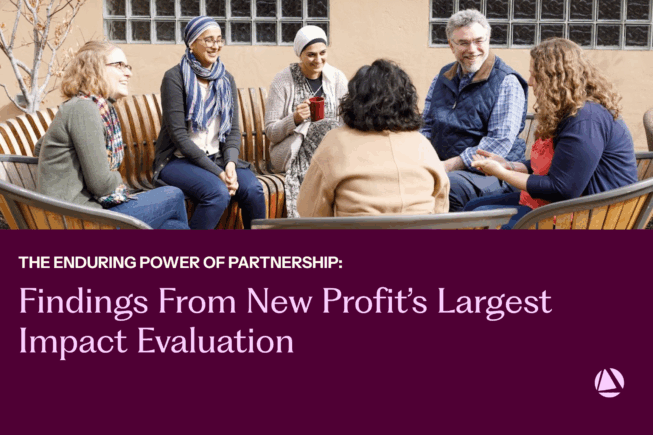
A recent independent evaluation by Brandeis University found that 100 percent of New Profit’s multi-year portfolio grantees reported satisfaction with their relationship and 92 percent said they benefited “a great deal” from working with the intermediary. Alumni leaders continued to report improvements in board development, leadership growth, organizational strategy, and access to networks years after formal funding ended. For early-stage organizations, 75 percent gained access to new funders and 65 percent secured unrestricted funding, helping to bridge the “capital chasm” many face. New Profit’s intentional combination of flexible funding and strategic support serves as an impact multiplier for philanthropists and nonprofits alike.
At the national level, trust in institutions has been declining precipitously in recent years. Yet new research from Edelman shows a slight uptick in the levels of trust people have in their neighbors and local communities. This mirrors a growing recognition in philanthropy that locally-driven solutions can address challenges while building trust. Community-based organizations have known this for a long time and philanthropy is finally beginning to listen.
Still, the majority of philanthropic funding flows to large, sophisticated organizations. While a growing interest in small, local nonprofits is a welcome development, overlooking mid-sized nonprofits misses a strategic opportunity to support the ‘missing middle’: organizations meaningfully guided by local constituencies with pathways to expand their impact at state, regional, or national levels through replication or widespread strategies.
For example, Grassroots Law & Organizing for Workers (GLOW), a New Profit grantee, works in “deep collaboration with worker centers and base-building organizations” to empower workers and challenge harmful employment practices. Organizations like GLOW and many others in New Profit’s portfolio doing this critical work often navigate some of the greatest challenges and tensions around leadership and organizational growth, impact monitoring and measurement, and ensuring sustainable economic models—perhaps because of this they remain underfunded despite their potential for outsized impact. Yet it is these kinds of organizations that hold significant potential to address persistent challenges while remaining accountable and connected to the communities they serve.
The pace of AI advancement is outstripping the sector’s capacity to absorb it. While some nonprofits have quickly designed and launched AI-native solutions, a growing divide is emerging between organizations with resources to integrate this technology and those without. Nonprofits with annual budgets exceeding $1 million are adopting AI tools at nearly twice the rate of smaller organizations. And, across the board, most nonprofits have not developed or communicated a clear AI strategy within their organization.
This isn’t a knowledge problem, it’s a structural one. The sector needs more deliberate infrastructure-building to support translating AI literacy into organizational readiness, including equipping organizations with the strategic capacity necessary to navigate tradeoffs as the technology continues to evolve. Additionally, the sector needs to explore the practices and principles that would enable nonprofits to co-design AI integrations in close partnership with their constituents and communities to ensure localized perspectives are centered.
There are emerging frameworks, like Project Evident’s Equitable AI Adoption Framework, developed to help “nonprofit organizations leverage AI while upholding their commitments to equity, safety, and responsibility.” This and similar efforts will enable the sector to more effectively evaluate AI solutions based on proof rather than promise, quickly address the emerging inequities with regard to the technology, and generate greater efficiencies and impact.
Leaders with flexible resources are best positioned to transform challenges into opportunities. Yet current funding structures often serve as barriers to adaptation, locking organizations into rigid deliverables and tracking outputs rather than outcomes. In a constrained fundraising environment, leaders often face an impossible choice between long-term impact and organizational survival.
The moment demands that philanthropy fundamentally rethink how it enables leadership. This means recognizing that flexibility provides leaders with the time and resources to assess, realign, and redesign for a volatile environment. The Brandeis findings show what’s possible when leaders receive sustained, flexible support: Leaders described their partners at New Profit as ‘trusted allies’ whose relationships continue to strengthen leadership capacity years after formal funding ends. It’s time for philanthropy to ensure this is the norm and not the exception.
What These Themes Mean for Leaders
For those deploying capital—whether you’re a foundation program officer, individual philanthropist, or leading a giving circle—this moment calls for approaches that are collaborative, community-driven, and patient. We must invest in leadership development and organizational resilience alongside direct service delivery.
For social entrepreneurs and nonprofit leaders, this means being transparent about challenges beyond your control while continuing to innovate. We must build communities of support rather than going it alone.
Change is the only constant. But change also creates the opportunity to ground our work in relationships, commit to continuous learning, and multiply our impact through trusted partnership. New Profit has seen firsthand the ways in which standing shoulder-to-shoulder with social entrepreneurs has served to enhance our understanding of the value of proximity and relationship-building to advancing impact. Over the coming months, our team will continue to surface insights and lessons that help funders navigate uncertainty and evolve our philanthropic practices together.