The Enduring Power of Partnership: Findings From New Profit’s Largest Impact Evaluation
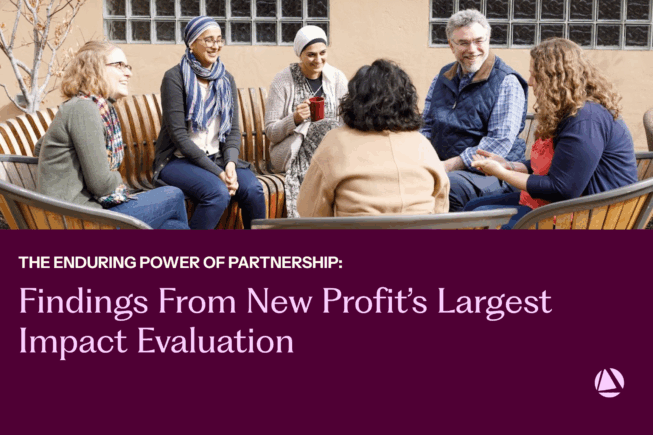
At a time when philanthropy is asking itself how to make real, measurable change, funders must take a clear-eyed look at the effectiveness of their grantmaking models. Earlier this year, an independent team at Brandeis University—commissioned by two of our anchor funders—conducted the most extensive study of New Profit’s impact in our 27-year history. The third-party evaluation found that our approach—combining capital, capacity, and community—delivers support that is trusted, effective, and enduring for proximate social entrepreneurs.
While we run our own monitoring efforts including annual satisfaction surveys, exit interviews, and internal reviews, this study was unique in its scope, scale, and rigor. The study included interviews and surveys with more than 300 participants and allowed the research team to develop a 360-degree view of our model in action. It is our largest and most comprehensive evaluation to date, and the first to include:
- Transform, Build, and Catalyze organizations, current and alumni
- Board Chairs from across the Build and Transform portfolios
- Deal Partners who worked directly with social entrepreneurs
- Data spanning nearly a decade, providing our first longitudinal view of impact
In our Build portfolio, which provides multi-year support to growth-stage organizations, 100 percent of social entrepreneurs reported satisfaction with their New Profit relationship, and 92 percent said they benefited “a great deal.” Board Chairs echoed that enthusiasm, giving New Profit a Net Promoter Score of 88—a level of trust rarely seen in any sector and well above industry benchmarks.
Even years after their formal partnership ended, alumni leaders continued to report improvement in board development, leadership growth, organizational strategy, and access to networks and partners. In other words, New Profit’s impact doesn’t stop when the investment does.
That durability, the study found, is fueled by relationships. More than three-quarters of entrepreneurs described their Deal Partner as a “trusted ally” and “critical friend.” They cited humility, flexibility, and an ability to provide challenge and support in equal measure as hallmarks of the relationship.
The study also examined our Catalyze portfolio, which supports early-stage organizations—most often led by leaders directly impacted or closely connected to the issues they’re working to address—with smaller grants and cohort-based learning. The results were just as encouraging:
- 75 percent of Catalyze leaders said New Profit helped them access new potential funders.
- 62 percent of alumni reported new funding relationships and 56 percent reported greater financial stability—critical measures for early-stage organizations.
- 65 percent have since received unrestricted funding, 60 percent secured multi-year grants, and 41 percent received grants of $1 million or more.
Many alumni credited New Profit for these gains, noting that the confidence, clarity, and networks built through the Catalyze experience helped them bridge the “capital chasm.”
The study reinforced what we’ve long believed: New Profit’s combination of flexible funding and strategic advising helps social entrepreneurs build resilient, high-performing organizations. The study also surfaced areas where we can go further—insights we value greatly as a continuous learning organization:
- Define clear arcs of the grantee journey: Social entrepreneurs and Deal Partners alike want more visible markers of progress and shared accountability throughout their multi-year investment.
- Strengthen systems change and sustainability support: Social entrepreneurs identified a growing need for partnership on systems change strategy and guidance to navigate policy, cross-sector collaboration, and field influence. They also reported a desire for increased support around strengthening their economic models and financial sustainability; areas where organizations are facing growing challenges given the more complex fundraising environment.
- Reimagine connection after investment: Alumni leaders spoke about a loss of connection once formal funding ends and expressed a desire to stay linked to the broader New Profit community and field-building efforts.
As the philanthropic sector looks for ways to navigate a challenging moment, these insights provide evidence of the power of partnership and how we as funding partners can evolve our practices to unlock greater impact.